Physicists have sought to detect ripples in spacetime called gravitational waves ever since they realized Albert Einstein’s general theory of relativity
predicted their existence. But only some of the most massive
astrophysical events, such mergers of black holes and neutron stars, can
produce gravitational waves strong enough to be detected on earth.
Since the 1990s, two laser-based facilities in Washington and Louisiana,
collectively known as LIGO, have tried to observe waves from such
events. They finally detected the first gravitational wave last
September, as announced on 11 February. Recent LIGO upgrades, including
more sensitive instruments and incorporation of detectors around the
world, should bring the detection of many more waves and open up a whole
new way of viewing cataclysmic events in the universe.
Gravitational waves, Einstein’s ripples in spacetime, spotted for first time
Long ago, deep in space, two massive black holes—the
ultrastrong gravitational fields left behind by gigantic stars that
collapsed to infinitesimal points—slowly drew together. The stellar
ghosts spiraled ever closer, until, about 1.3 billion years ago, they
whirled about each other at half the speed of light and finally merged.
The collision sent a shudder through the universe: ripples in the fabric
of space and time called gravitational waves. Five months ago, they
washed past Earth. And, for the first time, physicists detected the
waves, fulfilling a 4-decade quest and opening new eyes on the heavens. Here's the first person to spot those gravitational waves
The discovery marks a triumph for the 1000 physicists with the Laser
Interferometer Gravitational-Wave Observatory (LIGO), a pair of gigantic
instruments in Hanford, Washington, and Livingston, Louisiana. Rumors
of the detection had circulated for months. Today, at a press conference
in Washington, D.C., the LIGO team made it official. “We did it!” says
David Reitze, a physicist and LIGO executive director at the California
Institute of Technology (Caltech) in Pasadena. “All the rumors swirling
around out there got most of it right.”
Albert Einstein predicted the existence of gravitational waves 100
years ago, but directly detecting them required mind-boggling
technological prowess and a history of hunting. (See a timeline below of the history of the search for gravitational waves.) LIGO researchers sensed a wave that stretched space by one part in 1021,
making the entire Earth expand and contract by 1/100,000 of a
nanometer, about the width of an atomic nucleus. The observation tests
Einstein’s theory of gravity, the general theory of relativity, with
unprecedented rigor and provides proof positive that black holes exist.
“It will win a Nobel Prize,” says Marc Kamionkowski, a theorist at Johns
Hopkins University in Baltimore, Maryland.
LIGO watches for a minuscule stretching of space with what amounts to
ultraprecise rulers: two L-shaped contraptions called interferometers
with arms 4 kilometers long. Mirrors at the ends of each arm form a long
“resonant cavity,” in which laser light of a precise wavelength bounces
back and forth, resonating just as sound of a specific pitch rings in
an organ pipe. Where the arms meet, the two beams can overlap. If they
have traveled different distances along the arms, their waves will wind
up out of step and interfere with each other. That will cause some of
the light to warble out through an exit called a dark port in synchrony
with undulations of the wave.
From the interference, researchers can compare the relative lengths
of the two arms to within 1/10,000 the width of a proton—enough
sensitivity to see a passing gravitational wave as it stretches the arms
by different amounts. To spot such tiny displacements, however,
scientists must damp out vibrations such as the rumble of seismic waves,
the thrum of traffic, and the crashing of waves on distant coastlines.
V. Altounian/Science
On 14 September 2015, at 9:50:45 universal time—4:50 a.m. in
Louisiana and 2:50 a.m. in Washington—LIGO’s automated systems detected
just such a signal. The oscillation emerged at a frequency of 35 cycles
per second, or Hertz, and sped up to 250 Hz before disappearing 0.25
seconds later. The increasing frequency, or chirp, jibes with two
massive bodies spiraling into each other. The 0.007-second delay between
the signals in Louisiana and Washington is the right timing for a
light-speed wave zipping across both detectors.
The signal exceeds the “five-sigma” standard of statistical
significance that physicists use to claim a discovery, LIGO researchers
report in a paper scheduled to be published in Physical Review Letters
to coincide with the press conference. It’s so strong it can be seen in
the raw data, says Gabriela González, a physicist at Louisiana State
University, Baton Rouge, and spokesperson for the LIGO scientific
collaboration. “If you filter the data, the signal is obvious to the
eye,” she says.
Comparison with computer simulations reveals that the wave came from
two objects 29 and 36 times as massive as the sun spiraling to within
210 kilometers of each other before merging. Only a black hole—which is
made of pure gravitational energy and gets its mass through Einstein’s
famous equation E=mc2—can pack so much mass into so little
space, says Bruce Allen, a LIGO member at the Max Planck Institute for
Gravitational Physics in Hanover, Germany. The observation provides the
first evidence for black holes that does not depend on watching hot gas
or stars swirl around them at far greater distances. “Before, you could
argue in principle whether or not black holes exist,” Allen says. “Now
you can’t.”
The collision produced an astounding, invisible explosion. Modeling
shows that the final black hole totals 62 solar masses—3 solar masses
less than the sum of the initial black holes. The missing mass vanished
in gravitational radiation—a conversion of mass to energy that makes an
atomic bomb look like a spark. “For a tenth of a second [the collision]
shines brighter than all of the stars in all the galaxies,” Allen says.
“But only in gravitational waves.”
The LIGO facility in Livingston, Louisiana, has a twin in Hanford, Washington.
Other stellar explosions called gamma-ray bursts can also briefly
outshine the stars, but the explosive black-hole merger sets a
mind-bending record, says Kip Thorne, a gravitational theorist at
Caltech who played a leading role in LIGO’s development. “It is by far
the most powerful explosion humans have ever detected except for the big
bang,” he says.
For 5 months, LIGO physicists struggled to keep a lid on their
pupating discovery. Ordinarily, most team members would not have known
whether the signal was real. LIGO regularly salts its data readings with
secret false signals called “blind injections” to test the equipment
and keep researchers on their toes. But on 14 September 2015, that blind
injection system was not running. Physicists had only recently
completed a 5-year, $205 million upgrade of the machines, and several
systems—including the injection system—were still offline as the team
wound up a preliminary “engineering run.” As a result, the whole
collaboration knew that the observation was likely real. “I was
convinced that day,” González says.
Still, LIGO physicists had to rule out every alternative, including
the possibility that the reading was a malicious hoax. “We spent about a
month looking at the ways that somebody could spoof a signal,” Reitze
says, before deciding it was impossible. For González, making the checks
“was a heavy responsibility,” she says. “This was the first detection
of gravitational waves, so there was no room for a mistake.”
Proving that gravitational waves exist may not be LIGO’s most
important legacy, as there has been compelling indirect evidence for
them. In 1974, U.S. astronomers Russell Hulse and Joseph Taylor
discovered a pair of radio-emitting neutron stars called pulsars
orbiting each other. By timing the pulsars, Taylor and colleague Joel
Weisberg demonstrated that they are very slowly spiraling toward each
other—as they should if they’re radiating gravitational waves.
It is by far the most powerful explosion humans have ever detected except for the big bang.
It is the prospect of the science that might be done with
gravitational waves that really excites physicists. For example, says
Kamionkowski, the theorist at Johns Hopkins, the first LIGO result shows
the power of such radiation to reveal unseen astrophysical objects like
the two ill-fated black holes. “This opens a new window on this vast
population of stellar remnants that we know are out there but of which
we have seen only a tiny fraction,” he says.
The observation also paves the way for testing general relativity as
never before, Kamionkowski says. Until now, physicists have studied
gravity only in conditions where the force is relatively weak. By
studying gravitational waves, they can now explore extreme conditions in
which the energy in an object’s gravitational field accounts for most
or all of its mass—the realm of strong gravity so far explored by
theorists alone.
Rainer Weiss at the New York Science Fair.
Matt Weber
With the black hole merger, general relativity has passed the first
such test, says Rainer Weiss, a physicist at the Massachusetts Institute
of Technology (MIT) in Cambridge, who came up with the original idea
for LIGO. “The things you calculate from Einstein’s theory look exactly
like the signal,” he says. “To me, that’s a miracle.”
The detection of gravitational waves marks the culmination of a
decades-long quest that began in 1972, when Weiss wrote a paper
outlining the basic design of LIGO. In 1979, the National Science
Foundation funded research and development work at both MIT and Caltech,
and LIGO construction began in 1994. The $272 million instruments
started taking data in 2001, although it was not until the upgrade that
physicists expected a signal.
If LIGO’s discovery merits a Nobel Prize, who should receive it?
Scientists say Weiss is a shoo-in, but he demurs. “I don’t like to think
of it,” he says. “If it wins a Nobel Prize, it shouldn’t be for the
detection of gravitational waves. Hulse and Taylor did that.” Many
researchers say other worthy recipients would include Ronald Drever, the
first director of the project at Caltech who made key contributions to
LIGO’s design, and Thorne, the Caltech theorist who championed the
project. Thorne also objects. “The people who really deserve the credit
are the experimenters who pulled this off, starting with Rai and Ron,”
he says.
Meanwhile, other detections may come quickly. LIGO researchers are
still analyzing data from their first observing run with their upgraded
detectors, which ended 12 January, and they plan to start taking data
again in July. A team in Italy hopes to turn on its rebuilt VIRGO
detector—an interferometer with 3-kilometer arms—later this year.
Physicists eagerly await the next wave. See more of Science's coverage of gravitational waves.
From prediction to reality: a history of the search for gravitational waves
1915 - Albert Einstein publishes general theory of relativity, explains gravity as the warping of spacetime by mass or energy
1916 - Einstein predicts massive objects whirling in certain ways will cause spacetime ripples—gravitational waves
1936 - Einstein has second thoughts and argues in a manuscript that the waves don't exist—until reviewer points out a mistake
1962 - Russian physicists M. E. Gertsenshtein and V. I. Pustovoit publish paper sketch optical method for detecting gravitational
waves—to no notice
1969 - Physicist Joseph Weber claims gravitational wave detection using massive aluminum cylinders—replication efforts fail
1972 - Rainer Weiss of the Massachusetts Institute of
Technology (MIT) in Cambridge independently proposes optical method for
detecting waves
1974 - Astronomers discover pulsar orbiting a neutron star
that appears to be slowing down due to gravitational radiation—work that
later earns them a Nobel Prize
1979 - National Science Foundation (NSF) funds California Institute of Technology in Pasadena and MIT to develop design for LIGO
1990 - NSF agrees to fund $250 million LIGO experiment
1992 - Sites in Washington and Louisiana selected for LIGO facilities; construction starts 2 years later
1995 - Construction starts on GEO600 gravitational wave detector in Germany, which partners with LIGO and starts taking data in 2002
1996 - Construction starts on VIRGO gravitational wave detector in Italy, which starts taking data in 2007
2002–2010 - Runs of initial LIGO—no detection of gravitational waves
2007 - LIGO and VIRGO teams agree to share data, forming a single global network of gravitational wave detectors
2010–2015 - $205 million upgrade of LIGO detectors
2015 - Advanced LIGO begins initial detection runs in September
2016 - On 11 February, NSF and LIGO team announce successful detection of gravitational waves
Related Issue
Science: 03/06/2015, Vol 347 Issue 6226
Nanotechnology- A Future Cure\\
Nanotechnology (“nanotech”) is the control of matter on a nuclear,
sub-atomic, and supramolecular scale. The soonest, broad portrayal of
nanotechnology alluded to the specific mechanical objective of
absolutely controlling particles and atoms for creation of macroscale
items, likewise now alluded to as sub-atomic nanotechnology. A more
summed up portrayal of nanotechnology was in this manner set up by the
National Nanotechnology Initiative, which characterizes nanotechnology
as the control of matter with no less than one measurement estimated
from 1 to 100 nanometers. This definition mirrors the way that quantum
mechanical impacts are essential at this quantum-domain scale, thus the
definition moved from a specific innovative objective to an exploration
class comprehensive of a wide range of examination and advances that
arrangement with the exceptional properties of matter that happen
underneath the given size edge.
A nano brain is a calculated gadget with hugely parallel
computational capacities, taking after the data handling standards of
the human cerebrum. This machine get together would serve as a canny
choice making unit for nanorobots[clarification needed]. One key element
of a nano mind is that it would secure every single tactile data from
the outer environment, and in preparing that data, create unmistakable
guidelines for each and every execution unit joined with the nano
cerebrum simultaneously. Thus, the registering machine will correspond
with the outside world in a comparable manner to our focal sensory
system.
Organic neural system in Human mind develops consistently amid whole
life period, it picks up folds. There are a few endeavors to acknowledge
transformative circuits, however dominant part of these endeavors amass
a couple of static circuits and pick one of them amid computation.
Human cerebrum’s advancement is practically diverse, neurons change
association with make short-course, these courses lead to quicker choice
making, we call it expanding effectiveness through learning.
A
nano-cerebrum changes association between distinctive sub-processors in a
fundamentally the same style, accordingly it learns with experience,
since no equipment confinement is forced in the nano-mind, conceivable
outcomes of changing is gigantically extensive, not cosmic since
limitation because of asset impediment forces a furthest breaking point,
then again, that number of plausibility extents in the request of
millions contrasted with tens in the present advancing fittings.
Nanoparticles that convey chemotherapy medicates specifically to
disease cells are a work in progress. Tests are in advancement for
focused on conveyance of chemotherapy medications and their last
approbation for their utilization with tumor patients is pending. One
organization, CytImmune has distributed the aftereffects of a Phase 1
Clinical Trial of their initially focused on chemotherapy medication and
another organization, BIND Biosciences, has distributed preparatory
consequences of a Phase 1 Clinical Trial for their initially focused on
chemotherapy sedate and is continuing with a Phase 2 Clinical Trial.
There are a few layers of subprocessors one top of another that
constitute the nano mind, the base most layer join with the outside
machines or sensors and the top-most layer convey the principal decides
that are never showed signs of change amid nano cerebrum calculation. In
the event that nano cerebrum is made of cell machine then number of
cells declines in each layer as processing travels upward. The implanted
cell robot bunch that speak to whole nano mind, takes after two unique
classes of cell machine rules. Top of the line of tenets are those which
are followed in the phone machine network, and alternate class of
standards are essentially the move principles between two cell robot
layers, every layers are termed as sub-processors.
Scientists are now using nanotechnology for not only brain mapping but also as a medicine.
One use of nanotechnology in solution as of now being produced
includes utilizing nanoparticles to convey medications, warmth, light or
different substances to particular sorts of cells, (for example,
disease cells). Particles are built with the goal that they are pulled
in to sick cells, which permits direct treatment of those cells. This
strategy diminishes harm to solid cells in the body and considers prior
discovery of sickness.
Desktop PCs don’t normally accompany assembled in Wi-Fi, particularly
more seasoned models. So on the off chance that you have to get remote
network on your beige box, you have a couple of alternatives: you can
utilize either USB Wi-Fi connector, a PCI-E Wi-Fi card, another
motherboard with implicit Wi-Fi. Throughout the years, I have utilized or helped introduce PCI cards,
USB connectors and motherboards with implicit Wi-Fi. What you ought to
purchase isn’t a straightforward answer. In all cases, it relies on upon
your needs.
USB WI-FI Adapters
You know how you connect your blaze drive to your PC’s USB port and
it just works? That is precisely how a USB Wi-Fi connector functions,
which is the thing that makes it the most advantageous choice. The first
occasion when, you may need to introduce drivers, yet from that point
on, it’s simply fitting and-play.
WI-FI PCI Cards
USB connectors for the most part offer the same sort of network that
you will get on motherboards with inherent Wi-Fi, unless you utilize the
previously stated trap of utilizing a USB center point to broaden that.
For more steady associations crosswise over bigger separations, and
better throughput, Wi-Fi PCI cards have worked better as far as I can
tell. Obviously, it isn’t the answer for everybody.
WI-FI Enabled Motherboards
In case you’re hoping to redesign your PC at any rate, it may bode
well to overhaul your motherboard than purchase a connector. Such
motherboards don’t offer any execution support over USB or PCI cards,
yet you aren’t taking up that PCI or USB port. Now and again, redesigning may even be a superior arrangement. I was
considering purchasing a better than average 802.11b/g/n PCI card for my
6-year-old PC (about $40), however doing the math, it appeared well and
good to redesign the motherboard and processor. With that update (which
cost a sum of $180 after trade), I now have a PC that will be
functioning admirably for the following 4-5 years.
WI-FI Routers
In case of wi-fi routers you have to take help of a professional who
will do the settings on router along with your pc.After that just open
ur pc and login in your account voila your home is w-fi zoned. Contingent upon the above data, you ought to have the capacity to
make sense of the best thing to purchase for your needs. Yet, when you
hit the business sector, verify you consider the other vital elements as
well. Purchase something that is all around surveyed, and purchase a
connector that has the right speed for your system (e.g., a connector
with Wireless N rather than Wireless G). You may additionally think
about purchasing as a connector with super-quick 802.11ac, the length of
you have good switch—or arrangement on getting one sooner rather than
late future.
Sunday, 28 February 2016
Alternatives for Google Reader to Keep Tabs on RSS Feeds
Along with the BlackBerry Google Voice app, Google Building Maker,
Snapseed Desktop, Google Cloud Connect, and others, Google Reader is
being swept away (assuming the various petitions – 1, 2, and 3 – in place don’t stop it) in Google’s spring clean up. “Google Reader will not be available after July 1, 2013” says the
popup message when jumping into Google reader today (March 15th). According to the blog post, published on the 13th of March:
“We launched Google Reader in 2005 in an effort to make it easy for
people to discover and keep tabs on their favorite websites. While the
product has a loyal following, over the years usage has declined. So, on
July 1, 2013, we will retire Google Reader. Users and developers
interested in RSS alternatives can export their data, including their
subscriptions, with Google Takeout over the course of the next four
months.” ~ Urs Hölzle, SVP Technical Infrastructure and Google Fellow
What is the value of an RSS reader anyway?
To understand the value of a reader, you must first understand RSS. To put it in sample context, consider this. You visit a web site
regularly. It could be a blog, but doesn’t have to be. Perhaps you like a
particular author on the site, or a specific category, or you use a
particular search phrase on the site regularly, or maybe you like all of
the content on the site. Now, rather than visiting the site every day, you want a simple way of knowing when new content is published. There are a few ways to do that. Email alerts can be setup (often
based on feeds, incidentally, if they are done in an automated way), but
a popular way is to pull the feed into a personal reader. The “feed” is automatically updated, or even “dynamically” updated
when referenced. Either way, as new content is added to the site, the
category, the search results, the whatever, subscribers of the feed can see the content in their reader. Google Reader was a great way to pull several feeds together and categorize them and mash them up any way that you see fit. I personally liked it because it’s simple to use, and it’s a Google
product. Being a Google product, if I’m logged into my Google Account
(Gmail, G+, AdSense, AdWords, Alerts, etc), I’m logged into my Reader
account as well. It’s just convenient really, and the layout is typical and user friendly.
What’s a feed junkie to do?
Now with Google Reader gone, how can a person keep track of their feeds? Well, to answer that it really depends on what the feeds were used for in the first place. A journalist or web site owner, for example, may aggregate a bunch of
content in a particular niche, say… “Internet News,” so that they can
report on the news and write articles based on it. Well, in that case, following specific companies in the industry on
Twitter and Google Plus can keep the journalist abreast on the latest
news. Creating Twitter lists and Google+ circles helps “categorize” the
content. Also, Facebook is another way to keep track of “news” in a given
industry. While there might be other, and newer ways to categorize
content, one way is to create a Facebook Page to post your own “news” to
for a specific niche. Then, “like” all the companies and sites you wish to follow, and the news feed, when using Facebook as
that page will be specific to those “likes,” in what is hopefully a
particular niche. So, in this case, each Facebook page created can be
the start of a “category” to be used in the same way that lists are used
in Twitter, and circles are used in Google+. However, with the new categorizable news feed being rolled out in
Facebook there may be simpler ways to keep tabs on specific industries
in an organized way.
Other RSS reader options
There are plenty of RSS readers that exist across the web, many that
are free, some that you must pay for. A lot are web based (i.e. in the
cloud and accessible from multiple devices), and some are downloadable
software, and some will sync with local and cloud content. 1) The Old Reader
– This reader, dubbed “the ultimate social RSS reader,” was built after
the re-design of Google Reader in order to bring back features that
many have missed from the previous Google version. 2) NetVibes
– The NetVibes reader is a cloud-based, or web-based reader with many
features similar to that of Google Reader. It offers an iGoogle-like
homepage, plus a Google Reader-like UI. 3) Flipboard
– Flipboard is a different way to “subscribe” to the web. It is an app
for handheld devices that let users subscribe to a variety of feeds and
“flip” through pages of content in a graphical magazine-like format. 4) FeedReader
– Feed-reader is a downloadable solution for Windows and Linux users,
plus there is a browser-based, so therefore OS-irrelevant, version as
well. 5) Feedly
– Feedly is a popular web-based choice with multi-device and
multi-browser support. Plus, if you liked the “star” or “save for later”
feature of Google Reader, that feature exists here as well, as many a
good reader should. 6) Digg – Digg announced that they have a reader in the works that is to mimic Google Reader in some ways, and advance on it in others. “We hope to identify and rebuild the best of Google Reader’s
features,” they wrote, “but also advance them to fit the Internet of
2013.”
Tell Your Readers
This topic is important whether you are a Google Reader user
currently or not. If you have a web site with a feed, whether you made
that feed easily discoverable or not, people are probably subscribed to
it using Google Reader. To verify that, open Google Reader, then subscribe to your own feed.
Hover over your feed in the list in the left column, and click the down
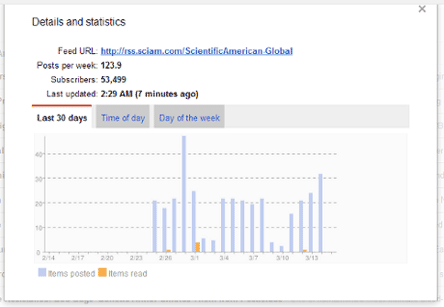
arrow that shows up to the right. Choose the “View details and statistics” option and check the
“Subscribers” value. That number reflects how many people you stand to
lose as subscribers if they didn’t “get the memo.” Well, even if they did, it might be wise to explain how to move to a new system and offer a step by step procedure for doing so. If you like, you can just link them to this post, then inlcude a
#movefromgooglereader at the end of the URL, and they can follow along
with the steps below.
Move from Google Reader to The Old Reader in 4 simple steps
While The Old Reader could benefit from a new name
(arguably), it may just be the simplest move from Google Reader. It’s a
free, full featured, social RSS reader, which trutfully can be looked at
as an upgrade from Google Reader if you consider the “social feature
removal” that Google made in the past. Step 1) Go to The Old Reader web site – The first step is to head over to theoldreader.com. Step 2) Login to the reader interface – The next
step is to choose which method to login, whether it be Facebook or
Google+. My personal choice is Facebook. While not everyone has a
Facebook account, even less people have a Google+ account even if they
do use Google Reader, so I will follow along here using the Facebook
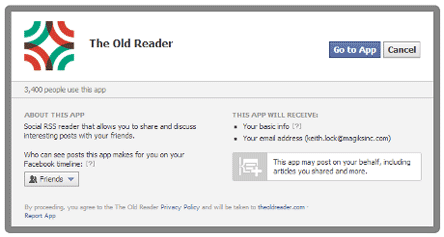
login method. I will assume that you are already logged in to Facebook. Now we just
have to give The Old Reader permission to use your Facebook credentials
to log in. Click “Facebook” at the top right of the screen. Choose your level of
privacy. If you really want to use the social aspects of the reader
then keep it set as “Friends” or change it to “Public,” otherwise choose
“Only Me,” and click “Go to App.” You should then be redirected to the reader interface and be presented with a message that says: “Successfully authorized via Facebook account.“ Step 3) Export feeds from Google Reader – Perhaps this should have been the first step but if you use the link provided it will open in a new tab. Head over to Google Takeout and login using your Reader account credentials. Your archive options will show just “Google Reader.” From there click “Create Archive” where you will be redirected to the
“Download” section to watch the progress of the export. Now, download
the file to your computer. Note: Many people are attempting to use the Google
Takeout feature for Google Reader exporting right now, and for some it
is not working. An alternative is to click this link ( https://www.google.com/reader/subscriptions/export ) to download just the XML file. Step 4) Import feeds – Now it’s time to import your feeds from the old reader into The Old Reader, err, I mean the new reader Depending which method you choose in the previous step, you might
have ended up with a zip file or a single XML file. The zip file will
contain extra data that can be used elsewhere, but for this import we
will be working with just the basic Subscription XML file (which was
downloaded from either method). Click on the “Import” link at the top right of the screen. Click
“Choose File.” Locate the file from your computer and click “Import.” The Pac-Man like progress indicator will chomp away while it uploads
your data to the queue. Your feed will be processed in turn and “might
take up to several hours.”
In conclusion :-
While losing Google Reader to some may seem like an unfortunate
thing, perhaps there is a bright side. It may provide the opportunity to
try new software that you might not have known existed. This software
may contain new features that could be beneficial to your business. Perhaps new sites and resources were discovered because of this change. All in all, sometimes it’s just nice to start anew. I personally have discovered ways that others have used RSS readers
that gives them ideas for new content. I added two new sites to my new
reader that have valuable content. I’m trying an alternative way to
subscribe to content by using Flipboard, and I was able to share this
post.