Let me tell you about the largest
business opportunity the world has ever seen. It’s larger than the
entire world economy today and it is about to happen right now. A year ago, I published a piece called “The Untapped $140 Trillion Innovation For Jobs Market”
saying that a people-centered economy, increasing the value of people,
beats todays task-centered economy, minimizing the cost of tasks. It’s better business for people,
companies, countries — everyone. People have been telling me it sounds
great, but they don’t trust my word on the $140 trillion. That sounds like a lot, considering that the entire world economy is $75 trillion today. So here I am back to explain. First, let me tell you that I have been too humble, $140 Trillion is an underestimate. Here are the facts: According to Gallup, 5 billion people are of
working age. 3 billion earn money in some way, most of them want a job
with steady pay. But only 1.3 billion have one — and out of them, only 200M, or 13%, are engaged in their job. What’s more, for every engaged worker, there are two who hate their
job. This is the sad state of the global workforce that creates $75
trillion dollars of market value each year. Human capacity is the
world’s most underutilized resource. Now, imagine a much better world — the
people-centered economy — where three billion workers have jobs
tailored to fit their unique sets of skills, talents, passions, where
they work with people they are inspired by and productive together with,
where they engage in the most meaningful and fruitful opportunities
that can be found for them.
Coit Tower Mural photo courtesy of Flickr/under_volcano.
We might as well round that up to five billion people, because anyone of working age would want that job. So let’s compare: a workforce with 200
million engaged workers – most of them utilizing only a fraction of
their true talents and capacities – creates $75 trillion market value.
How much more market value will be created by a workforce with
twenty-five times as many engaged workers, each one with that
needle-in-a-haystack perfectly matched job that you and I can only dream
about having today? The extra value created is the untapped market for innovation for jobs. $140 Trillion is a very humble estimate, indeed. The question: if it’s so great, why has it not happened already? Because, until now, tailored jobs for
everyone on planet earth was impossible. However, since only a year or
two back it is becoming possible. The high smartphone penetration and
new infrastructures like cloud computing and big data analytics makes it
possible to match up a person with a very special skill in Alaska with
another special skill in Indonesia to serve a customer with a very
special need in Angola. All people have special interests and capacities that have no known
market, until today that is, if entrepreneurs will find ways of turning
them into inspired, high-performance teams and buyers and sellers who
make each other satisfied. The scaling effect of that is
enormous. You only need a few dozens of potential buyers among the five
billion customers in order to have a market price. Today, we can do it.
This is a brand new opportunity.
Coit Tower Mural photo courtesy of Flickr/Gary Stevens.
For this reason, Uber is not the solution to the future of work. Why? Because it is task-centered, not
people-centered. It standardizes the task of driving a cab so that
virtually anyone can do it. The only reason why people could earn well
on it until now is because Uber is so much more efficient than existing
taxi systems that they can charge a lower ride price and still give more
to the driver. Still, at the end of the day, there
are only so many people who need a cab ride, there are emerging other
Uber-like competitors, and the supply of Uber-drivers is so large, that
the margins will shrink until Uber-drivers earn peanuts. It’s already
happening. Uber doesn’t care if you can write poetry that brings people
to tears or if you can save kids from becoming drug addicts, it doesn’t
affect the price you can charge as a driver. You, the worker, are a
commodity. You might as well be a machine. If companies have a thousand competitors for the same customers, what do they do? They diversify! This is what people must do, too. They will increase their value by
being unique, not by fitting the slot. But people don’t have the money
or other resources to do the research required to match their potential
with a potential niche market, create new types of services, re-brand
and market to customers, like companies do.
If
companies have a thousand competitors for the same customers, what do
they do? They diversify! This is what people must do, too.
This is the market opportunity for the innovation-for-jobs ecosystem.
Today, with smart use of selective marketing, like Facebook or Google
ads, applying matchmaking algorithms like the ones used by Match.com and
others, smart startups can become the shaping, branding and marketing
agencies of the working customer, helping her to earn better, in more
meaningful ways. Today, more companies help people spend better. People can’t spend
more than they earn, so it’s a limited market. If they instead helped
people earn better, applying the business model “I earn when you earn”,
the limitations disappear. The opportunity is limitless. Serving the earners is the defining market, serving the spenders will
be the consequential one. We are seeing the beginning of a revolution
in strengths finding, education, matchmaking, HR and the creation of
opportunities in a long-tail labor market. Sebastian Thrun’s education company
Udacity just recently took the step from a task-centered to a
people-centered business model. The new business model goes like this:
You pay x dollars for a course. You get back half the money when you
pass the course. You get back the rest if you don’t get a job within x
months. In other words, Udacity has gone from
“We sell you skills that you can earn money with” to “We earn money when
you earn money”. Now, you might point out that Udacity will earn money
on all of the students that pay for the course without completing it. This is true, but I would not
recommend Udacity to pursue that as their main stream of revenue,
because it will kill the company. They simply can’t give themselves an
incentive to make their students fail. If I were Sebastian, I would
donate the “fail”-revenues to worthy causes, just to avoid introducing
self-destructive incentives. The incentive to make students get good
jobs, that’s the winning proposition. I run the innovation for jobs i4j Leadership Forum
together with Vint Cerf, co-inventor of the Internet. By now, we are a
few hundred thought leaders, involved in an intense exchange of ideas
around how to develop the innovation-for-jobs ecosystem. We have just now published our first book, with support from the Kauffman Foundation, “Disrupting Unemployment”. We lay out the vision of a people-centered economy, innovation for jobs, and so on, with chapters by selected i4j Leadership Forum participants, edited by Max Senges: Philip Auerswald, Robert B. Cohen, Dan Harple, Mohammad Islam, Joi Ito, Steve Jurvetson, Sven Otto Littorin, Geoffrey Moore, Monique Morrow, Mitchel Resnick, Philipp Schmidt, Jim Spohrer, Esther Wojcicki. Today, when people ask me what my goal
is, I answer honestly “to eradicate joblessness”. That, and the $140
Trillion dollars brings on some amusement. Well… my partner co-invented the Internet, so that is a good start.
This Gadget Tests Food For Gluten In Under 2 Minutes
More people than ever are realizing that bread isn’t supposed to make
a person bloated and sick and perhaps they have a sensitivity to
gluten. Or worse, they’re allergic. The Nima from 6SensorLabs could change the lives of these people and not just those with a gluten allergy. “Mason, I just want to know what Cheez-its taste like,” my daughter
told my son a few months back. It was just a musing of a six-year old,
but the comment breaks my heart. She was diagnosed with Celiac when she
was 14-months old after a series of tests trying to determine why she
was critically under-developed. Now she’s a healthy six year old, but
like many others, struggles with food on a daily basis because she’s
allergic to gluten. Most people with allergies are pretty good at identifying risky
items. The Nima is designed to be an extra safeguard for questionable
times (are those french fries gluten free?), instead of something a
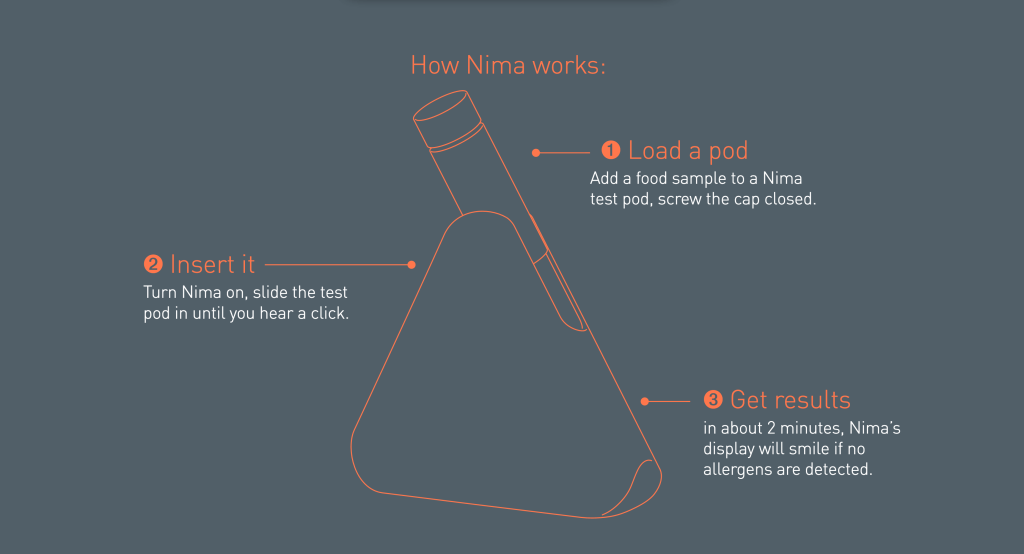
person would use for every meal. The Nima takes two minutes to identify if there’s gluten in food.
This is done using an antibody-based test that the founders say produce
results on par with what’s done in labs. The device uses disposable pods
that breaks down a sample of a food item. Each pod costs $3.99 and the
device will retail for $249. The pods will be sold in packs of on a
monthly basis.
The pods can be configured to test for other allergies, additives and
pathogens. Peanut and dairy pods are already in development. After the Nima determines the results of the test, the data is
uploaded to a database the company is building that could be added to
discovery apps like Yelp or Foursquare. It’s important to note that 6SensorLabs does not need FDA approval
for the Nima. The device simply tests for gluten and the company does
not make any claims on the impact of a person’s health. 6SensorLab is currently taking pre-orders for the device.
Autonomous machines have gripped our imagination ever since the first robot flickered on the silver screen in the 1927 film Metropolis.
Most of the robots we know today—unglamorous devices like robotic
welders on car assembly lines and the Roomba vacuum cleaner—fall short
of those in science fiction. But our relationship with robots is about
to become far more intimate. Would you be comfortable with a robot
butler, or a self-driving car? How about a robo-scientist toiling away
next to you at the bench, not only pipetting but also formulating
hypotheses and designing experiments?
As robots become more sophisticated, psychological paradoxes
are coming into sharper relief. Robots that look human strike many of
us as downright creepy, while robots that act human—when they are
programmed, for example, to cheat at cards—somehow put us at ease. And
no matter how uncannily lifelike some of today's robots may seem, the
resemblance is skin-deep. A stubborn challenge has been endowing robots
with not only the capability to sense their environment, but also the
wits to make sense of it. Robots will get there eventually, and when
that happens we'll be confronted with a new array of ethical and moral
questions. Questions like: Should robots be accorded rights as sentient
beings? The rise of the machines will be anything but predictable.
Which movies get artificial intelligence right?
Take Science’s quiz and test your knowledge of AI in the movies!In the opening scene of the 1982 film Blade Runner, an
interrogator asks an android named Leon questions “designed to provoke
an emotional response.” According to the movie, empathy is one of the
few features that distinguish humans from artificial intelligence (AI).
When the test shifts to questions about his mother, Leon stands up,
draws a gun, and shoots his interviewer to death.It’s not a happy ending for the human, but when Hollywood portrays
AI, it rarely is. Writers and directors have been pitting man against
machine on the silver screen for decades, but just how scientifically
plausible are these plots? We consulted a group of AI experts and asked
them to weigh in on 10 different films in the genre. We’ve ranked them
least to most plausible. (Danger, Will Robinson: Spoilers ahead.)
ALPHA CORE/COLUMBIA PICTURES/GENRE FILMS/OLIN STUDIO/SONY PICTURES ENTERTAINMENT / THE KOBAL COLLECTION
ALPHA CORE/COLUMBIA PICTURES/GENRE FILMS/OLIN STUDIO/SONY PICTURES ENTERTAINMENT/THE KOBAL COLLECTION10. Chappie (2015)Summary: A robot police warrior gains self-awareness after a programmer cracks the code for true AI. What it gets right: Chappie is
“born” with a very basic understanding of the world and his
surroundings, but it learns through experience. Although the film might
not be the most realistic portrayal of machine learning, it is accurate
in the sense that many of our most advanced AI algorithms today require
the robot to undergo a trial-and-error learning phase. “Certainly the
fact that he learns very quickly is potentially quite realistic,” says
Stuart Russell, a computer scientist at the University of California,
Berkeley, and the author of Artificial Intelligence: A Modern Approach. What it gets wrong: There are a lot of problems with
this movie, according to the experts. For one, there’s a single rogue
programmer who writes a program for AI by himself in his apartment. The
experts agree this sort of breakthrough is highly unrealistic, and that
the first true AI will be developed slowly over time by a large team of
scientists. Another issue: brain/consciousness uploading—the idea that
somehow human consciousness can be extracted from a human brain and
replicated on a chip—which is a major theme in the movie. “It’s pure
speculation that has no basis in fact whatsoever,” Russell says. “It’s
nonsense.” That strikes a blow to the idea, popularized by futurist Ray
Kurzweil, that we’ll one day be able to upload our consciousness into
computers, granting us immortality, adds Randy Goebel, a computer
scientist at the University of Alberta in Canada who studies the theory
and application of intelligent systems. “Kurzweil is just plain wrong.” Realism score: 1/10
AMBLIN/DREAMWORKS/WB / THE KOBAL COLLECTION / JAMES, DAVID
AMBLIN/DREAMWORKS/WB / THE KOBAL COLLECTION/JAMES, DAVID9. A.I. (2001)Summary: After their son must be
put into a hibernationlike stasis to save his life, a family adopts a
robotic boy, David, which is programmed to love. What it gets right: Throughout the film, David has
one unchanging objective that is the direct result of his programming—to
love and be loved. He never goes rogue or changes his goals. “This
robot boy wants to be loved. If you design this robot child in such a
way, it will have these desires and it will act in such a way,” says
Marcus Hutter, a computer scientist at the Australian National
University who studies mathematical approaches to AI. “Since the aim of
the company was to produce artificial children, it makes a lot of sense
that this AI behaved as it did.” What it gets wrong: Like in Chappie, we see
a single team of scientists create AI over a very short period of time.
“I cringe when I watch that, starting from scratch in 18 months, they
achieve a conscious robot,” Hutter says. “And then there’s a button you
press to turn on the consciousness module.” Then there’s the matter of
David and his kin’s integration into the larger world. “I thought the
robots in A.I. were too well accepted into society,” Russell says. Realism score: 3/10
LADD COMPANY/WARNER BROS / THE KOBAL COLLECTION
LADD COMPANY/WARNER BROS / THE KOBAL COLLECTION8. Blade Runner (1982)Summary: In the future, humanity’s
genetic engineering technology allows for the creation organic life in a
form completely indistinguishable from humans, but these “replicants”
only live for 4 years and aren’t allowed on Earth. What it gets right: By opting for organic AI over mechanical, Blade Runner
asks if consciousness can be grown in a lab. “How do I know that you
have feelings?” Hutter asks. “I have no way of really knowing that. I
just assume that because you are built up similarly to me and I know
that I have emotions.” By being “built up similarly,” the replicants
muddy the waters of defining consciousness even further, he says. What it gets wrong: The experts were somewhat
divided on Ridley Scott’s critically acclaimed foray into film noire.
Hutter rated it as his “least favorite” with respect to realism whereas
some of his colleagues placed it more in the middle of the pack. The
replicants’ sentienceseems to be derived, at least in part, from their
implanted memories. Now, no genetic engineering technique can implant
complex memories into humans. Realism score: 4/10
DNA FILMS/FILM4 / THE KOBAL COLLECTION
DNA FILMS/FILM4/THE KOBAL COLLECTION7. Ex Machina (2015)Summary: A young programmer (Caleb)
wins a trip to visit a computer genius’s (Nathan) compound where he
will get to administer a Turing test (designed to test whether a machine
is capable of humanlike intelligence) to a potentially sentient robot
(Ava). What it gets right: Nathan doesn’t
suddenly “crack the AI problem.” He’s not sure if Ava is sentient or
not; she needs to be tested. Although Hutter thinks the movie bungled
the accuracy on the Turing test, he praises it for its sophisticated
treatment of consciousness and for avoiding over-the-top action scenes.
Consciousness is one of the biggest themes in all of these films, and
Hutter thinks that if consciousness is ever achieved, it’s likely to be
an emergent property of advanced AI rather than something that was
explicitly programmed or activated: “In general I would say that if I
have a system which is sufficiently complicated … if they display
behavior we would interpret as emotions as humans, then there’s a
reasonable chance that it has emotions.” Ex Machina at least treats the subject as complicated—something that needs to be tested. Russell is less optimistic that such a test will ever be needed. “I
don’t think anyone’s going to crack consciousness—at least not absent a
major conceptual breakthrough,” he says. “It’s not going to come from
programming; it’s going to come from a complete philosophical conception
of what we’re talking about.” The problem, Russell says, is that we
don’t understand the origins of our own consciousness well enough to
program one. “Nobody in AI is working on building conscious machines
because we just have nothing to go on,” he says. “We just don’t have a
clue about what to do.” What it gets wrong: Yet again we see the “isolated
genius” trope. Though Nathan runs the massive internet company BlueBook,
it appears most of his work on AI has been done solo—alone in a
high-tech house in the woods. The film also has a particularly poor
explanation of the technology behind Ava’s (maybe) sentient brain. (This
is somewhat forgivable considering we don’t know how to create AI in
the first place.) In the scene in question, Nathan shows Caleb the
various pieces of hardware inside of Ava. When they get to the brain,
Nathan mentions it’s not hardware, but “wetware” implying a biological
component. But the software behind Ava’s intelligence is apparently
derived from compiling the massive amount of data in Internet searches.
How search queries equate to sentience is never explained in any detail.
The lack of specifics is especially surprising given how excited Nathan
is to expound upon the ins and outs of the tech behind Ava’s genitals. Realism score: 5/10
ALCON ENTERTAINMENT / THE KOBAL COLLECTION
ALCON ENTERTAINMENT/THE KOBAL COLLECTION6. Transcendence (2014)Summary: Computer scientist Will Caster becomes the
first world’s first AI specimen when his consciousness is uploaded to a
quantum computer after he dies. What it gets right: Until the very
end, Will Caster’s AI self is confined entirely to the digital world; he
exists solely as a computer program. The experts agree that shrugging
off a physical body could allow an AI considerable freedoms and safety.
“Once you have the ability to change the mind or the brain you can also
get rid of a lot of evolutionary artifacts,” Hutter says. “I don’t think
they’ll care so much about becoming like humans.” What it gets wrong: The wholebrain uploading/downloading thing. (See #10.) Realism score: 6/10
20TH CENTURY FOX / THE KOBAL COLLECTION
20TH CENTURY FOX/THE KOBAL COLLECTION5. I, Robot (2004)Summary: After an executive (Alfred
Lanning) at USR robotics corporation is murdered, detective Del Spooner
suspects a one of the company’s own robots is the perpetrator. What it gets right: Of any film on the list, I, Robot
addresses Isaac Asimov’s three laws of robotics most directly: 1) A
robot may not injure a human being or, through inaction, allow a human
being to come to harm; 2) A robot must obey orders given it by human
beings except where such orders would conflict with the First Law; 3) A
robot must protect its own existence as long as such protection does not
conflict with the First or Second Law. On their own, the laws might be a fairly good starting point for
creating safe AIs. Sonny, the film’s main robotic character, appears to
have somehow defied his programming and gone rogue. According to the
experts, this is something that could never happen, but I, Robot
provides a very reasonable explanation for the machines’ sudden change
of behavior when it is revealed that an AI named VIKI has introduced the
“Zeroth law” which states: “A robot may not harm humanity, or, by
inaction, allow humanity to come to harm.” Like in many of the other
films on the list, this directive is taken to the extreme when the
robots decide that humanity is a danger to itself and must be pacified.
Unpredicted and unwanted consequences could become a reality if we
aren’t careful about how we program advanced AIs. Plus, Spooner’s Audi is totally rad. What it gets wrong: Adding the Zeroth law or any other
overriding directive to the robots’ programming could certainly allow
them the change their behavior and violate the traditional Three Laws of
Robotics, but this doesn’t explain why or how VIKI came to the decision
to implement the Zeroth law to begin with. All the experts are quick to
point out that robots do not change their programming, and the notion
that they could spontaneously develop new agendas is pure fiction.
Hutter says the underlying goals programmed into the machine are
“static.” “There are mathematical theories that prove a perfectly
rational goal-achieving agent has no motivation to change its own
goals.” Realism score: 6.5/10
UNIVERSAL / THE KOBAL COLLECTION
UNIVERSAL/THE KOBAL COLLECTION4. Colossus: The Forbin Project (1970)Summary: An American
supercomputer designed to prevent nuclear war teams up with its Russian
counterpart and together, with control over most of the world’s nukes,
they hold humanity at ransom unless humans relinquish control of society
to their new computer overlords. What it gets right: In Hollywood there seems
to be a misconception that a machine must acquire sentience or free
will to oppose humans. But according to Russell, “It’s completely
unnecessary. It’s completely nonscientific.” Whether the supercomputers
are sentient in this film is debatable, but they wouldn’t need to be to
oppose humanity. All the machine needs is programming that contradicts
with our own wants. “If we give these machines goals and we’re not very
careful about it, they’ll do what we asked them to, but we may not like
the results,” Russell says. Hutter goes so far as to say that he might
not mind being ruled by a sentient machine. Humans are greedy and prone
to pursue self-interest even at the expense of others, he notes. A
completely rational computer, with intelligence far beyond our own,
might actually be able to create a more fair society for everyone. He
agrees with Colossus when, at the film’s conclusion, the AI states, “You
will say you lose your freedom. Freedom is an illusion. All you lose is
the emotion of pride.” What it gets wrong: Aside from the idea that
a computer operating on punch cards would have enough computational
power to outwit and subjugate humanity, there isn’t too much wrong with
Colossus. In a 2001 publication, computer scientist Rodney Brooks
pointed out that the progression of any technology happens in
incremental steps. If we ever create a robot that we can’t control, we
will most likely have already created many robots that we almost
couldn’t control or a robot that we occasionally lost control of. He
thinks there will be plenty of warning if we ever get close. Considering
IBM’s Watson didn’t even know it was playing Jeopardy when it
bested Ken Jennings and Brad Rutter in 2011, it seems likely that we
have some time. Realism score: 7/10
TOUCHSTONE/THE KOBAL COLLECTION/BRAY, PHIL3. Bicentennial Man(1999)Summary: A robot butler becomes human over several generations, even replacing his mechanical pieces with lab-grown organs. What it gets right: For the first time in
our list, we have nonviolent AI. Although it doesn’t make for a very
compelling story, most of the experts are optimistic that humanity will
be able to peacefully coexist alongside AI. “As far as accuracy, there
aren’t any things that are outrageous,” Goebel says. “The fear or
anxiety that Hollywood portrays … is maybe the most serious thing
that’s mistreated.” What it gets wrong: Hutter says the notion
that a robot as advanced as Andrew would have any desire to become human
is probably “somewhat egocentric.” Like in Transcendence, sufficiently
advanced machines may recognize the benefits or their inorganic
circuitry. Perhaps it’s missing the entire point of the film, but it
seems unlikely that AI as smart as Andrew would think relish the
opportunity to become fragile or breakable. And, as always, there’s the
issue that Andrew has inexplicably obtained goals and wants outside of
his original programming. Realism score: 7.5/10
ANNAPURNA PICTURES / THE KOBAL COLLECTION
ANNAPURNA PICTURES/THE KOBAL COLLECTION2. Her (2013)Summary: A recently divorced writer
(Theodore Twombly) installs a new sentient operating system (Samantha)
on his computer and the two begin dating. What it gets right: Samantha doesn’t have a body, but she does have a voice. Her
shows the risks of becoming emotionally attached to machines, and does
so without the need to package AI into a humanoid frame. Russell, in
particular, warns of designing humanoid AIs. “People are going to become
emotionally attached,” he says. “You’re less likely to ascribe
consciousness to a grey box. That’s one reason I think it’s a bad reason
to have humanoid robots. Imagine how difficult that [would be] for a
child growing up.” And furthermore, AI may have different interests than its
human creators. In the film, Theodore Twombly may grow as a result of
his relationship with Samantha, but the two were clearly never an ideal
pair. Samantha was free to roam the Internet and the world, carrying out
hundreds of conversations at once. Twombly is confined to the
limitations of his body and brain. “Machines don’t have to experience
the world at the same rate at humans,” Russell says. That makes them
great for performing millions of computations per second, but pretty
lousy companions. What it gets wrong: There’s
no explanation for how Samantha works or what it means to evolve beyond
the need for matter. Also, considering how advanced AI has become, the
rest of civilization appears strangely unchanged. Realism score: 8/10
MGM/STANLEY KUBRICK PRODUCTIONS / THE KOBAL COLLECTION
MGM/STANLEY KUBRICK PRODUCTIONS/THE KOBAL COLLECTION1. 2001: A Space OdysseySummary: While investigating a strange signal emanating from a large black monolith on the moon, the crew of Discovery One discover that their onboard AI (HAL 9000) is malfunctioning. What it gets right: The experts seem to
agree that 2001’s treatment of AI is the most accurate of any of the
movies on the list. HAL seems certainly seems sentient, but when asked
whether the computer has feelings or emotions, one of the astronauts
(Dave) responds that there’s really no way to know. When asked if he
would believe a computer that claimed to have feelings, Russell says
something similar: “It could be that we end up just shrugging our
shoulders.” HAL seems to express fear as Dave slowly deactivates him,
but the desperate pleading could just be one final attempt to carry out
his mission.
HAL also sticks to his programming. Like Colossus, HAL never
strays from his original goals. All of his seemingly nefarious actions
are carried out simply because he believes it is the best way to
complete the mission. It’s not a survival instinct or emotion that makes
HAL into a villain, just simple programming. 2001 makes it clear that
consciousness is not a requirement for AI opposition. What it gets wrong: Not too much. You don’t
get to the top of this list by messing up too royally. We took a point
off because there’s no explanation of how HAL works, but again, since we
don’t know how to build an advanced AI, no explanation might be better
than some vague science jargon. Realism score: 9/10
Astronomers say a Neptune-sized planet lurks beyond Pluto
By Eric Hand
The solar system appears to have a new ninth planet. Today, two
scientists announced evidence that a body nearly the size of
Neptune—but as yet unseen—orbits the sun every 15,000 years. During the
solar system’s infancy 4.5 billion years ago, they say, the giant planet
was knocked out of the planet-forming region near the sun. Slowed down
by gas, the planet settled into a distant elliptical orbit, where it
still lurks today.
The claim is the strongest yet in the centuries-long search for a
“Planet X” beyond Neptune. The quest has been plagued by far-fetched
claims and even outright quackery. But the new evidence comes from a
pair of respected planetary scientists, Konstantin Batygin and Mike
Brown of the California Institute of Technology (Caltech) in Pasadena,
who prepared for the inevitable skepticism with detailed analyses of the
orbits of other distant objects and months of computer simulations. “If
you say, ‘We have evidence for Planet X,’ almost any astronomer will
say, ‘This again? These guys are clearly crazy.’ I would, too,” Brown
says. “Why is this different? This is different because this time we’re
right.”
Mike Brown (left) and Konstantin Batygin.
LANCE HAYASHIDA/CALTECH
Outside scientists say their calculations stack up and express a
mixture of caution and excitement about the result. “I could not imagine
a bigger deal if—and of course that’s a boldface ‘if’—if it turns out
to be right,” says Gregory Laughlin, a planetary scientist at the
University of California (UC), Santa Cruz. “What’s thrilling about it is
[the planet] is detectable.”
Batygin and Brown inferred its presence from the peculiar clustering
of six previously known objects that orbit beyond Neptune. They say
there’s only a 0.007% chance, or about one in 15,000, that the
clustering could be a coincidence. Instead, they say, a planet with the
mass of 10 Earths has shepherded the six objects into their strange
elliptical orbits, tilted out of the plane of the solar system.
The orbit of the inferred planet is similarly tilted, as well as
stretched to distances that will explode previous conceptions of the
solar system. Its closest approach to the sun is seven times farther
than Neptune, or 200 astronomical units (AUs). (An AU is the distance
between Earth and the sun, about 150 million kilometers.) And Planet X
could roam as far as 600 to 1200 AU, well beyond the Kuiper belt, the
region of small icy worlds that begins at Neptune’s edge about 30 AU.
If Planet X is out there, Brown and Batygin say, astronomers ought to
find more objects in telltale orbits, shaped by the pull of the hidden
giant. But Brown knows that no one will really believe in the discovery
until Planet X itself appears within a telescope viewfinder. “Until
there’s a direct detection, it’s a hypothesis—even a potentially very
good hypothesis,” he says. The team has time on the one large telescope
in Hawaii that is suited for the search, and they hope other astronomers
will join in the hunt.
Killing Pluto was fun, but this is head and shoulders above everything else.
Batygin and Brown published the result today in The Astronomical Journal.
Alessandro Morbidelli, a planetary dynamicist at the Nice Observatory
in France, performed the peer review for the paper. In a statement, he
says Batygin and Brown made a “very solid argument” and that he is
“quite convinced by the existence of a distant planet.”
Championing a new ninth planet is an ironic role for Brown; he is
better known as a planet slayer. His 2005 discovery of Eris, a remote
icy world nearly the same size as Pluto, revealed that what was seen as
the outermost planet was just one of many worlds in the Kuiper belt.
Astronomers promptly reclassified Pluto as a dwarf planet—a saga Brown
recounted in his book How I Killed Pluto.
Now, he has joined the centuries-old search for new planets. His
method—inferring the existence of Planet X from its ghostly
gravitational effects—has a respectable track record. In 1846, for
example, the French mathematician Urbain Le Verrier predicted the
existence of a giant planet from irregularities in the orbit of Uranus.
Astronomers at the Berlin Observatory found the new planet, Neptune,
where it was supposed to be, sparking a media sensation.
Remaining hiccups in Uranus’s orbit led scientists to think that
there might yet be one more planet, and in 1906 Percival Lowell, a
wealthy tycoon, began the search for what he called “Planet X” at his
new observatory in Flagstaff, Arizona. In 1930, Pluto turned up—but it
was far too small to tug meaningfully on Uranus. More than half a
century later, new calculations based on measurements by the Voyager
spacecraft revealed that the orbits of Uranus and Neptune were just fine
on their own: No Planet X was needed.
Yet the allure of Planet X persisted. In the 1980s, for example,
researchers proposed that an unseen brown dwarf star could cause
periodic extinctions on Earth by triggering fusillades of comets. In the
1990s, scientists invoked a Jupiter-sized planet at the solar system’s
edge to explain the origin of certain oddball comets. Just last month,
researchers claimed to have detected the faint microwave glow of an
outsized rocky planet some 300 AU away, using an array of telescope
dishes in Chile called the Atacama Large Millimeter Array (ALMA). (Brown
was one of many skeptics, noting that ALMA’s narrow field of view made
the chances of finding such an object vanishingly slim.)
Brown got his first inkling of his current quarry in 2003, when he
led a team that found Sedna, an object a bit smaller than both Eris and
Pluto. Sedna’s odd, far-flung orbit made it the most distant known
object in the solar system at the time. Its perihelion, or closest point
to the sun, lay at 76 AU, beyond the Kuiper belt and far outside the
influence of Neptune’s gravity. The implication was clear: Something
massive, well beyond Neptune, must have pulled Sedna into its distant
orbit.
(DATA) JPL; BATYGIN AND BROWN/CALTECH; (DIAGRAM) A. CUADRA/SCIENCE
That something didn’t have to be a planet. Sedna’s gravitational
nudge could have come from a passing star, or from one of the many other
stellar nurseries that surrounded the nascent sun at the time of the
solar system’s formation.
Since then, a handful of other icy objects have turned up in similar
orbits. By combining Sedna with five other weirdos, Brown says he has
ruled out stars as the unseen influence: Only a planet could explain
such strange orbits. Of his three major discoveries—Eris, Sedna, and
now, potentially, Planet X—Brown says the last is the most sensational.
“Killing Pluto was fun. Finding Sedna was scientifically interesting,”
he says. “But this one, this is head and shoulders above everything
else.”
Brown and Batygin were nearly beaten to the punch. For years, Sedna
was a lone clue to a perturbation from beyond Neptune. Then, in 2014,
Scott Sheppard and Chad Trujillo (a former graduate student of Brown’s)
published a paper describing the discovery of VP113, another object that
never comes close to the sun. Sheppard, of the Carnegie Institution for
Science in Washington, D.C., and Trujillo, of the Gemini Observatory in
Hawaii, were well aware of the implications. They began to examine the
orbits of the two objects along with 10 other oddballs. They noticed
that, at perihelion, all came very near the plane of solar system in
which Earth orbits, called the ecliptic. In a paper, Sheppard and
Trujillo pointed out the peculiar clumping and raised the possibility
that a distant large planet had herded the objects near the ecliptic.
But they didn’t press the result any further.
Later that year, at Caltech, Batygin and Brown began discussing the
results. Plotting the orbits of the distant objects, Batygin says, they
realized that the pattern that Sheppard and Trujillo had noticed “was
only half of the story.” Not only were the objects near the ecliptic at
perihelia, but their perihelia were physically clustered in space (see
diagram, above).
For the next year, the duo secretly discussed the pattern and what it
meant. It was an easy relationship, and their skills complemented each
other. Batygin, a 29-year-old whiz kid computer modeler, went to college
at UC Santa Cruz for the beach and the chance to play in a rock band.
But he made his mark there by modeling the fate of the solar system over
billions of years, showing that, in rare cases, it was unstable:
Mercury may plunge into the sun or collide with Venus. “It was an
amazing accomplishment for an undergraduate,” says Laughlin, who worked
with him at the time.
Brown, 50, is the observational astronomer, with a flair for dramatic
discoveries and the confidence to match. He wears shorts and sandals to
work, puts his feet up on his desk, and has a breeziness that masks
intensity and ambition. He has a program all set to sift for Planet X in
data from a major telescope the moment they become publicly available
later this year.
Their offices are a few doors down from each other. “My couch is
nicer, so we tend to talk more in my office,” Batygin says. “We tend to
look more at data in Mike’s.” They even became exercise buddies, and
discussed their ideas while waiting to get in the water at a Los
Angeles, California, triathlon in the spring of 2015.
First, they winnowed the dozen objects studied by Sheppard and
Trujillo to the six most distant—discovered by six different surveys on
six different telescopes. That made it less likely that the clumping
might be due to an observation bias such as pointing a telescope at a
particular part of the sky.
Batygin began seeding his solar system models with Planet X’s of
various sizes and orbits, to see which version best explained the
objects’ paths. Some of the computer runs took months. A favored size
for Planet X emerged—between five and 15 Earth masses—as well as a
preferred orbit: antialigned in space from the six small objects, so
that its perihelion is in the same direction as the six objects’
aphelion, or farthest point from the sun. The orbits of the six cross
that of Planet X, but not when the big bully is nearby and could disrupt
them. The final epiphany came 2 months ago, when Batygin’s simulations
showed that Planet X should also sculpt the orbits of objects that swoop
into the solar system from above and below, nearly orthogonal to the
ecliptic. “It sparked this memory,” Brown says. “I had seen these
objects before.” It turns out that, since 2002, five of these highly
inclined Kuiper belt objects have been discovered, and their origins are
largely unexplained. “Not only are they there, but they are in exactly
the places we predicted,” Brown says. “That is when I realized that this
is not just an interesting and good idea—this is actually real.”
Sheppard, who with Trujillo had also suspected an unseen planet, says
Batygin and Brown “took our result to the next level. …They got deep
into the dynamics, something that Chad and I aren’t really good with.
That’s why I think this is exciting.”
Others, like planetary scientist Dave Jewitt, who discovered the
Kuiper belt, are more cautious. The 0.007% chance that the clustering of
the six objects is coincidental gives the planet claim a statistical
significance of 3.8 sigma—beyond the 3-sigma threshold typically
required to be taken seriously, but short of the 5 sigma that is
sometimes used in fields like particle physics. That worries Jewitt, who
has seen plenty of 3-sigma results disappear before. By reducing the
dozen objects examined by Sheppard and Trujillo to six for their
analysis, Batygin and Brown weakened their claim, he says. “I worry that
the finding of a single new object that is not in the group would
destroy the whole edifice,” says Jewitt, who is at UC Los Angeles. “It’s
a game of sticks with only six sticks.”
IMAGES: WIKIMEDIA COMMONS; NASA/JPL-CALTECH; A. CUADRA/SCIENCE; NASA/JHUAPL/SWRI; (DIAGRAM) A. CUADRA/SCIENCE
At first blush, another potential problem comes from NASA’s Widefield
Infrared Survey Explorer (WISE), a satellite that completed an all-sky
survey looking for the heat of brown dwarfs—or giant planets. It ruled
out the existence of a Saturn-or-larger planet as far out as 10,000 AU,
according to a 2013 study by Kevin Luhman, an astronomer at Pennsylvania
State University, University Park. But Luhman notes that if Planet X is
Neptune-sized or smaller, as Batygin and Brown say, WISE would have
missed it. He says there is a slim chance of detection in another WISE
data set at longer wavelengths—sensitive to cooler radiation—which was
collected for 20% of the sky. Luhman is now analyzing those data.
Even if Batygin and Brown can convince other astronomers that Planet X
exists, they face another challenge: explaining how it ended up so far
from the sun. At such distances, the protoplanetary disk of dust and gas
was likely to have been too thin to fuel planet growth. And even if
Planet X did get a foothold as a planetesimal, it would have moved too
slowly in its vast, lazy orbit to hoover up enough material to become a
giant.
Instead, Batygin and Brown propose that Planet X formed much closer
to the sun, alongside Jupiter, Saturn, Uranus, and Neptune. Computer
models have shown that the early solar system was a tumultuous billiards
table, with dozens or even hundreds of planetary building blocks the
size of Earth bouncing around. Another embryonic giant planet could
easily have formed there, only to be booted outward by a gravitational
kick from another gas giant.
It’s harder to explain why Planet X didn’t either loop back around to
where it started or leave the solar system entirely. But Batygin says
that residual gas in the protoplanetary disk might have exerted enough
drag to slow the planet just enough for it to settle into a distant
orbit and remain in the solar system. That could have happened if the
ejection took place when the solar system was between 3 million and 10
million years old, he says, before all the gas in the disk was lost into
space.
Hal Levison, a planetary dynamicist at the Southwest Research
Institute in Boulder, Colorado, agrees that something has to be creating
the orbital alignment Batygin and Brown have detected. But he says the
origin story they have developed for Planet X and their special pleading
for a gas-slowed ejection add up to “a low-probability event.” Other
researchers are more positive. The proposed scenario is plausible,
Laughlin says. “Usually things like this are wrong, but I’m really
excited about this one,” he says. “It’s better than a coin flip.”
All this means that Planet X will remain in limbo until it is actually found.
Astronomers have some good ideas about where to look, but spotting
the new planet won’t be easy. Because objects in highly elliptical
orbits move fastest when they are close to the sun, Planet X spends very
little time at 200 AU. And if it were there right now, Brown says, it
would be so bright that astronomers probably would have already spotted
it.
Instead, Planet X is likely to spend most of its time near aphelion,
slowly trotting along at distances between 600 and 1200 AU. Most
telescopes capable of seeing a dim object at such distances, such as the
Hubble Space Telescope or the 10-meter Keck telescopes in Hawaii, have
extremely tiny fields of view. It would be like looking for a needle in a
haystack by peering through a drinking straw.
One telescope can help: Subaru, an 8-meter telescope in Hawaii that
is owned by Japan. It has enough light-gathering area to detect such a
faint object, coupled with a huge field of view—75 times larger than
that of a Keck telescope. That allows astronomers to scan large swaths
of the sky each night. Batygin and Brown are using Subaru to look for
Planet X—and they are coordinating their efforts with their erstwhile
competitors, Sheppard and Trujillo, who have also joined the hunt with
Subaru. Brown says it will take about 5 years for the two teams to
search most of the area where Planet X could be lurking.
The 8-meter Subaru Telescope atop Mauna Kea in Hawaii has a large field of view—enabling it to search efficiently for Planet X.
Subaru Telescope, NAOJ
If the search pans out, what should the new member of the sun’s
family be called? Brown says it’s too early to worry about that and
scrupulously avoids offering up suggestions. For now, he and Batygin are
calling it Planet Nine (and, for the past year, informally, Planet
Phattie—1990s slang for “cool”). Brown notes that neither Uranus nor
Neptune—the two planets discovered in modern times—ended up being named
by their discoverers, and he thinks that that’s probably a good thing.
It’s bigger than any one person, he says: “It’s kind of like finding a
new continent on Earth.”
He is sure, however, that Planet X—unlike Pluto—deserves to be called
a planet. Something the size of Neptune in the solar system? Don’t even
ask. “No one would argue this one, not even me.”
Physicists have sought to detect ripples in spacetime called gravitational waves ever since they realized Albert Einstein’s general theory of relativity
predicted their existence. But only some of the most massive
astrophysical events, such mergers of black holes and neutron stars, can
produce gravitational waves strong enough to be detected on earth.
Since the 1990s, two laser-based facilities in Washington and Louisiana,
collectively known as LIGO, have tried to observe waves from such
events. They finally detected the first gravitational wave last
September, as announced on 11 February. Recent LIGO upgrades, including
more sensitive instruments and incorporation of detectors around the
world, should bring the detection of many more waves and open up a whole
new way of viewing cataclysmic events in the universe.
Gravitational waves, Einstein’s ripples in spacetime, spotted for first time
Long ago, deep in space, two massive black holes—the
ultrastrong gravitational fields left behind by gigantic stars that
collapsed to infinitesimal points—slowly drew together. The stellar
ghosts spiraled ever closer, until, about 1.3 billion years ago, they
whirled about each other at half the speed of light and finally merged.
The collision sent a shudder through the universe: ripples in the fabric
of space and time called gravitational waves. Five months ago, they
washed past Earth. And, for the first time, physicists detected the
waves, fulfilling a 4-decade quest and opening new eyes on the heavens. Here's the first person to spot those gravitational waves
The discovery marks a triumph for the 1000 physicists with the Laser
Interferometer Gravitational-Wave Observatory (LIGO), a pair of gigantic
instruments in Hanford, Washington, and Livingston, Louisiana. Rumors
of the detection had circulated for months. Today, at a press conference
in Washington, D.C., the LIGO team made it official. “We did it!” says
David Reitze, a physicist and LIGO executive director at the California
Institute of Technology (Caltech) in Pasadena. “All the rumors swirling
around out there got most of it right.”
Albert Einstein predicted the existence of gravitational waves 100
years ago, but directly detecting them required mind-boggling
technological prowess and a history of hunting. (See a timeline below of the history of the search for gravitational waves.) LIGO researchers sensed a wave that stretched space by one part in 1021,
making the entire Earth expand and contract by 1/100,000 of a
nanometer, about the width of an atomic nucleus. The observation tests
Einstein’s theory of gravity, the general theory of relativity, with
unprecedented rigor and provides proof positive that black holes exist.
“It will win a Nobel Prize,” says Marc Kamionkowski, a theorist at Johns
Hopkins University in Baltimore, Maryland.
LIGO watches for a minuscule stretching of space with what amounts to
ultraprecise rulers: two L-shaped contraptions called interferometers
with arms 4 kilometers long. Mirrors at the ends of each arm form a long
“resonant cavity,” in which laser light of a precise wavelength bounces
back and forth, resonating just as sound of a specific pitch rings in
an organ pipe. Where the arms meet, the two beams can overlap. If they
have traveled different distances along the arms, their waves will wind
up out of step and interfere with each other. That will cause some of
the light to warble out through an exit called a dark port in synchrony
with undulations of the wave.
From the interference, researchers can compare the relative lengths
of the two arms to within 1/10,000 the width of a proton—enough
sensitivity to see a passing gravitational wave as it stretches the arms
by different amounts. To spot such tiny displacements, however,
scientists must damp out vibrations such as the rumble of seismic waves,
the thrum of traffic, and the crashing of waves on distant coastlines.
V. Altounian/Science
On 14 September 2015, at 9:50:45 universal time—4:50 a.m. in
Louisiana and 2:50 a.m. in Washington—LIGO’s automated systems detected
just such a signal. The oscillation emerged at a frequency of 35 cycles
per second, or Hertz, and sped up to 250 Hz before disappearing 0.25
seconds later. The increasing frequency, or chirp, jibes with two
massive bodies spiraling into each other. The 0.007-second delay between
the signals in Louisiana and Washington is the right timing for a
light-speed wave zipping across both detectors.
The signal exceeds the “five-sigma” standard of statistical
significance that physicists use to claim a discovery, LIGO researchers
report in a paper scheduled to be published in Physical Review Letters
to coincide with the press conference. It’s so strong it can be seen in
the raw data, says Gabriela González, a physicist at Louisiana State
University, Baton Rouge, and spokesperson for the LIGO scientific
collaboration. “If you filter the data, the signal is obvious to the
eye,” she says.
Comparison with computer simulations reveals that the wave came from
two objects 29 and 36 times as massive as the sun spiraling to within
210 kilometers of each other before merging. Only a black hole—which is
made of pure gravitational energy and gets its mass through Einstein’s
famous equation E=mc2—can pack so much mass into so little
space, says Bruce Allen, a LIGO member at the Max Planck Institute for
Gravitational Physics in Hanover, Germany. The observation provides the
first evidence for black holes that does not depend on watching hot gas
or stars swirl around them at far greater distances. “Before, you could
argue in principle whether or not black holes exist,” Allen says. “Now
you can’t.”
The collision produced an astounding, invisible explosion. Modeling
shows that the final black hole totals 62 solar masses—3 solar masses
less than the sum of the initial black holes. The missing mass vanished
in gravitational radiation—a conversion of mass to energy that makes an
atomic bomb look like a spark. “For a tenth of a second [the collision]
shines brighter than all of the stars in all the galaxies,” Allen says.
“But only in gravitational waves.”
The LIGO facility in Livingston, Louisiana, has a twin in Hanford, Washington.
Other stellar explosions called gamma-ray bursts can also briefly
outshine the stars, but the explosive black-hole merger sets a
mind-bending record, says Kip Thorne, a gravitational theorist at
Caltech who played a leading role in LIGO’s development. “It is by far
the most powerful explosion humans have ever detected except for the big
bang,” he says.
For 5 months, LIGO physicists struggled to keep a lid on their
pupating discovery. Ordinarily, most team members would not have known
whether the signal was real. LIGO regularly salts its data readings with
secret false signals called “blind injections” to test the equipment
and keep researchers on their toes. But on 14 September 2015, that blind
injection system was not running. Physicists had only recently
completed a 5-year, $205 million upgrade of the machines, and several
systems—including the injection system—were still offline as the team
wound up a preliminary “engineering run.” As a result, the whole
collaboration knew that the observation was likely real. “I was
convinced that day,” González says.
Still, LIGO physicists had to rule out every alternative, including
the possibility that the reading was a malicious hoax. “We spent about a
month looking at the ways that somebody could spoof a signal,” Reitze
says, before deciding it was impossible. For González, making the checks
“was a heavy responsibility,” she says. “This was the first detection
of gravitational waves, so there was no room for a mistake.”
Proving that gravitational waves exist may not be LIGO’s most
important legacy, as there has been compelling indirect evidence for
them. In 1974, U.S. astronomers Russell Hulse and Joseph Taylor
discovered a pair of radio-emitting neutron stars called pulsars
orbiting each other. By timing the pulsars, Taylor and colleague Joel
Weisberg demonstrated that they are very slowly spiraling toward each
other—as they should if they’re radiating gravitational waves.
It is by far the most powerful explosion humans have ever detected except for the big bang.
It is the prospect of the science that might be done with
gravitational waves that really excites physicists. For example, says
Kamionkowski, the theorist at Johns Hopkins, the first LIGO result shows
the power of such radiation to reveal unseen astrophysical objects like
the two ill-fated black holes. “This opens a new window on this vast
population of stellar remnants that we know are out there but of which
we have seen only a tiny fraction,” he says.
The observation also paves the way for testing general relativity as
never before, Kamionkowski says. Until now, physicists have studied
gravity only in conditions where the force is relatively weak. By
studying gravitational waves, they can now explore extreme conditions in
which the energy in an object’s gravitational field accounts for most
or all of its mass—the realm of strong gravity so far explored by
theorists alone.
Rainer Weiss at the New York Science Fair.
Matt Weber
With the black hole merger, general relativity has passed the first
such test, says Rainer Weiss, a physicist at the Massachusetts Institute
of Technology (MIT) in Cambridge, who came up with the original idea
for LIGO. “The things you calculate from Einstein’s theory look exactly
like the signal,” he says. “To me, that’s a miracle.”
The detection of gravitational waves marks the culmination of a
decades-long quest that began in 1972, when Weiss wrote a paper
outlining the basic design of LIGO. In 1979, the National Science
Foundation funded research and development work at both MIT and Caltech,
and LIGO construction began in 1994. The $272 million instruments
started taking data in 2001, although it was not until the upgrade that
physicists expected a signal.
If LIGO’s discovery merits a Nobel Prize, who should receive it?
Scientists say Weiss is a shoo-in, but he demurs. “I don’t like to think
of it,” he says. “If it wins a Nobel Prize, it shouldn’t be for the
detection of gravitational waves. Hulse and Taylor did that.” Many
researchers say other worthy recipients would include Ronald Drever, the
first director of the project at Caltech who made key contributions to
LIGO’s design, and Thorne, the Caltech theorist who championed the
project. Thorne also objects. “The people who really deserve the credit
are the experimenters who pulled this off, starting with Rai and Ron,”
he says.
Meanwhile, other detections may come quickly. LIGO researchers are
still analyzing data from their first observing run with their upgraded
detectors, which ended 12 January, and they plan to start taking data
again in July. A team in Italy hopes to turn on its rebuilt VIRGO
detector—an interferometer with 3-kilometer arms—later this year.
Physicists eagerly await the next wave. See more of Science's coverage of gravitational waves.
From prediction to reality: a history of the search for gravitational waves
1915 - Albert Einstein publishes general theory of relativity, explains gravity as the warping of spacetime by mass or energy
1916 - Einstein predicts massive objects whirling in certain ways will cause spacetime ripples—gravitational waves
1936 - Einstein has second thoughts and argues in a manuscript that the waves don't exist—until reviewer points out a mistake
1962 - Russian physicists M. E. Gertsenshtein and V. I. Pustovoit publish paper sketch optical method for detecting gravitational
waves—to no notice
1969 - Physicist Joseph Weber claims gravitational wave detection using massive aluminum cylinders—replication efforts fail
1972 - Rainer Weiss of the Massachusetts Institute of
Technology (MIT) in Cambridge independently proposes optical method for
detecting waves
1974 - Astronomers discover pulsar orbiting a neutron star
that appears to be slowing down due to gravitational radiation—work that
later earns them a Nobel Prize
1979 - National Science Foundation (NSF) funds California Institute of Technology in Pasadena and MIT to develop design for LIGO
1990 - NSF agrees to fund $250 million LIGO experiment
1992 - Sites in Washington and Louisiana selected for LIGO facilities; construction starts 2 years later
1995 - Construction starts on GEO600 gravitational wave detector in Germany, which partners with LIGO and starts taking data in 2002
1996 - Construction starts on VIRGO gravitational wave detector in Italy, which starts taking data in 2007
2002–2010 - Runs of initial LIGO—no detection of gravitational waves
2007 - LIGO and VIRGO teams agree to share data, forming a single global network of gravitational wave detectors
2010–2015 - $205 million upgrade of LIGO detectors
2015 - Advanced LIGO begins initial detection runs in September
2016 - On 11 February, NSF and LIGO team announce successful detection of gravitational waves
Related Issue
Science: 03/06/2015, Vol 347 Issue 6226
Nanotechnology- A Future Cure\\
Nanotechnology (“nanotech”) is the control of matter on a nuclear,
sub-atomic, and supramolecular scale. The soonest, broad portrayal of
nanotechnology alluded to the specific mechanical objective of
absolutely controlling particles and atoms for creation of macroscale
items, likewise now alluded to as sub-atomic nanotechnology. A more
summed up portrayal of nanotechnology was in this manner set up by the
National Nanotechnology Initiative, which characterizes nanotechnology
as the control of matter with no less than one measurement estimated
from 1 to 100 nanometers. This definition mirrors the way that quantum
mechanical impacts are essential at this quantum-domain scale, thus the
definition moved from a specific innovative objective to an exploration
class comprehensive of a wide range of examination and advances that
arrangement with the exceptional properties of matter that happen
underneath the given size edge.
A nano brain is a calculated gadget with hugely parallel
computational capacities, taking after the data handling standards of
the human cerebrum. This machine get together would serve as a canny
choice making unit for nanorobots[clarification needed]. One key element
of a nano mind is that it would secure every single tactile data from
the outer environment, and in preparing that data, create unmistakable
guidelines for each and every execution unit joined with the nano
cerebrum simultaneously. Thus, the registering machine will correspond
with the outside world in a comparable manner to our focal sensory
system.
Organic neural system in Human mind develops consistently amid whole
life period, it picks up folds. There are a few endeavors to acknowledge
transformative circuits, however dominant part of these endeavors amass
a couple of static circuits and pick one of them amid computation.
Human cerebrum’s advancement is practically diverse, neurons change
association with make short-course, these courses lead to quicker choice
making, we call it expanding effectiveness through learning.
A
nano-cerebrum changes association between distinctive sub-processors in a
fundamentally the same style, accordingly it learns with experience,
since no equipment confinement is forced in the nano-mind, conceivable
outcomes of changing is gigantically extensive, not cosmic since
limitation because of asset impediment forces a furthest breaking point,
then again, that number of plausibility extents in the request of
millions contrasted with tens in the present advancing fittings.
Nanoparticles that convey chemotherapy medicates specifically to
disease cells are a work in progress. Tests are in advancement for
focused on conveyance of chemotherapy medications and their last
approbation for their utilization with tumor patients is pending. One
organization, CytImmune has distributed the aftereffects of a Phase 1
Clinical Trial of their initially focused on chemotherapy medication and
another organization, BIND Biosciences, has distributed preparatory
consequences of a Phase 1 Clinical Trial for their initially focused on
chemotherapy sedate and is continuing with a Phase 2 Clinical Trial.
There are a few layers of subprocessors one top of another that
constitute the nano mind, the base most layer join with the outside
machines or sensors and the top-most layer convey the principal decides
that are never showed signs of change amid nano cerebrum calculation. In
the event that nano cerebrum is made of cell machine then number of
cells declines in each layer as processing travels upward. The implanted
cell robot bunch that speak to whole nano mind, takes after two unique
classes of cell machine rules. Top of the line of tenets are those which
are followed in the phone machine network, and alternate class of
standards are essentially the move principles between two cell robot
layers, every layers are termed as sub-processors.
Scientists are now using nanotechnology for not only brain mapping but also as a medicine.
One use of nanotechnology in solution as of now being produced
includes utilizing nanoparticles to convey medications, warmth, light or
different substances to particular sorts of cells, (for example,
disease cells). Particles are built with the goal that they are pulled
in to sick cells, which permits direct treatment of those cells. This
strategy diminishes harm to solid cells in the body and considers prior
discovery of sickness.
Desktop PCs don’t normally accompany assembled in Wi-Fi, particularly
more seasoned models. So on the off chance that you have to get remote
network on your beige box, you have a couple of alternatives: you can
utilize either USB Wi-Fi connector, a PCI-E Wi-Fi card, another
motherboard with implicit Wi-Fi. Throughout the years, I have utilized or helped introduce PCI cards,
USB connectors and motherboards with implicit Wi-Fi. What you ought to
purchase isn’t a straightforward answer. In all cases, it relies on upon
your needs.
USB WI-FI Adapters
You know how you connect your blaze drive to your PC’s USB port and
it just works? That is precisely how a USB Wi-Fi connector functions,
which is the thing that makes it the most advantageous choice. The first
occasion when, you may need to introduce drivers, yet from that point
on, it’s simply fitting and-play.
WI-FI PCI Cards
USB connectors for the most part offer the same sort of network that
you will get on motherboards with inherent Wi-Fi, unless you utilize the
previously stated trap of utilizing a USB center point to broaden that.
For more steady associations crosswise over bigger separations, and
better throughput, Wi-Fi PCI cards have worked better as far as I can
tell. Obviously, it isn’t the answer for everybody.
WI-FI Enabled Motherboards
In case you’re hoping to redesign your PC at any rate, it may bode
well to overhaul your motherboard than purchase a connector. Such
motherboards don’t offer any execution support over USB or PCI cards,
yet you aren’t taking up that PCI or USB port. Now and again, redesigning may even be a superior arrangement. I was
considering purchasing a better than average 802.11b/g/n PCI card for my
6-year-old PC (about $40), however doing the math, it appeared well and
good to redesign the motherboard and processor. With that update (which
cost a sum of $180 after trade), I now have a PC that will be
functioning admirably for the following 4-5 years.
WI-FI Routers
In case of wi-fi routers you have to take help of a professional who
will do the settings on router along with your pc.After that just open
ur pc and login in your account voila your home is w-fi zoned. Contingent upon the above data, you ought to have the capacity to
make sense of the best thing to purchase for your needs. Yet, when you
hit the business sector, verify you consider the other vital elements as
well. Purchase something that is all around surveyed, and purchase a
connector that has the right speed for your system (e.g., a connector
with Wireless N rather than Wireless G). You may additionally think
about purchasing as a connector with super-quick 802.11ac, the length of
you have good switch—or arrangement on getting one sooner rather than
late future.